


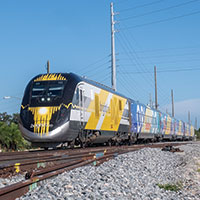
 Debt-ridden Brightline faces ‘probable’ default
STORY BY A STAFF WRITER (Week of January 15, 2025)
Brightline’s November revenue and ridership report starts out on a cheery note with a series of highlights about its performance during the month, noting that ridership was up 14 percent, year over year, to 280,136, while revenue climbed 18 percent.
But the upbeat tone sounds like whistling past the graveyard when you look deeper in the report, where the company says it “has been in discussions for the potential incurrence of up to $100 million of additional debt,” on top of the $5.5 billion it already owes, to stave off default and keep its trains running.
Making the picture darker, the company admits that “the terms and conditions of our existing indebtedness include restrictive covenants that limit our ability to incur debt, and we expect that we may need to obtain consent from certain holders of our debt to incur the additional debt.”
In other words, even though the company desperately needs cash, it may not be allowed to issue more bonds – even if it can find investors willing to buy them.
The report also says Brightline will have to use a portion of its “debt service reserve account to fund, in full or in part, the interest payment due on the Brightline Trains Florida Series 2024 Bonds” this month.
Not a good sign.
This news comes against the backdrop of multiple debt downgrades over the past year that have cut the value of the company’s most vulnerable corporate bonds to 26 cents on the dollar, meaning bondholders have lost 74 percent of their investment in a year’s time.
The most recent blow came in mid-December when S&P Global downgraded $2.2 billion of Brightline’s municipal bonds five notches, from BB-minus to CCC. It downgraded the affiliated bonds of Brightline’s backer, Fortress Investment Group, at the same time.
The move came as Brightline’s ridership and revenue fell far short of projections made last year, despite the increases noted in the report.
“We have sharply revised our [outlook] for Brightline Trains Florida LLC following a material deviation from our growth expectations in the second half of 2025, which resulted in a larger-than-anticipated revenue shortfall and faster consumption of liquidity reserves,” S&P analysts said in a Dec. 19 statement.
“Looking ahead, we now project lower growth in ticket revenue ... in 2026, leading us to expect a higher probability of default by January 2027 ... as liquidity available would be insufficient to meet debt service obligations.
“We think that switching riders from alternate modes [of transportation], automotive in particular, is more challenging than originally forecast,” S&P analysts concluded.
Representatives from Brightline did not respond to requests for comment by press time. Representatives from Fortress also declined comment.
The financial struggles of the high-speed passenger railroad could jeopardize construction of a Treasure Coast station in Stuart, a project that has faced its own local hurdles.
Martin County has agreed to fund a $60-million station at 500 Southeast Flagler Dr. in Stuart, with $15 million of its own money and $45 million in grants from the Federal Railroad Administration, but its first attempt to secure the grant money faltered and it has started the process over again.
“We expect the construction of the station, but not the maintenance or operations, to be 100 percent funded by sources other than Brightline,” the company said its report. But Martin County is unlikely to build a train station if the trains grind to a halt due to bankruptcy or some other form of default.
Brightline’s long-term financial outlook has always seemed dicey, but its current dead-man-at-the-switch trajectory began when it failed to pay interest on $1.2 million worth of bonds in July, garnering a series of downgrades and forcing it to pay nearly 15 percent on some of its debt going forward.
That failure, which did not amount to a default according to the terms of bonds, did not come as a complete surprise considering the train company’s recent financial condition.
The Palm Beach Post reported in May that the company lost a whopping $549 million in 2024.
“Brightline spent $341 million running and maintaining its trains and stations in 2024, bringing in about $188 million from ticket sales and other sources, for a deficit of more than $153 million,” according to the Post.
In addition, Brightline “paid $178 million in interest on its debt,” and another $218 million to refinance debt.
The company’s operating loss in the first half of 2025 exceeded $70 million, putting it on track for a $140 million loss during the year. Neither number includes its massive, ever-increasing interest payments or ongoing construction costs.
Attempting to find another way out, Brightline is looking to sell “equity in the train service to outside investors,” according to Miami radio station WLRN.
How much of the company it is looking to sell, at what price and to whom isn’t known, but Brightline said in the November report that it “continues to actively progress the planned issuance of a substantial amount of equity, with a global process underway engaging with numerous potential strategic partners.
“Equity proceeds would be used to repay principal and interest of existing debt and to increase cash reserves.”
Now backed by Fortress Investment Group, Brightline was founded as All Aboard Florida in 2012 and went through several changes in ownership before completing its 235-mile, high-speed rail line from Miami to Orlando in September 2023.
Charles Caloia contributed to this report.